There's a tempting fantasy in every busy creator's head: hand off the boring parts of bookmarking entirely and let a "done-for-you" service handle it. The fantasy is reasonable — submitting the same page across platforms, writing little blurbs, checking what stuck, is genuinely tedious work that doesn't need your brain. The trap is that most "done-for-you bookmarking" on the open market is a spam cannon: hundreds of identical submissions to dead platforms, fired in an hour, that add nothing a reader would ever see and quietly trip every spam filter watching.
The takeaway up front: a done-for-you workflow can absolutely add real value — but only if you design the workflow and keep the judgement, and the service merely executes the repetitive steps. Done well, you get hours back and your content reaches a few more real places. Done carelessly, you've paid to look spammy. The difference is entirely in how the workflow is built, so let's build it properly.
What "done-for-you" should and shouldn't mean
Done-for-you should mean the labor is done for you. It should not mean the thinking is done for you. Those are very different transactions.
When a service handles the labor, you've already decided which pages matter, which platforms are worth using, and how each listing should read — the service just files your plan. When a service does the thinking too, you get generic submissions chosen for volume and speed, with no regard for your audience or relevance. That's the version that produces spam, because spam is simply distribution with no judgement behind it.
If you've read the social bookmarking guide, you know that good bookmarking contributes something — a relevant page, in the right place, framed for a real reader. A done-for-you workflow has to preserve that, or it isn't worth doing.
Design the workflow before you hand anything off
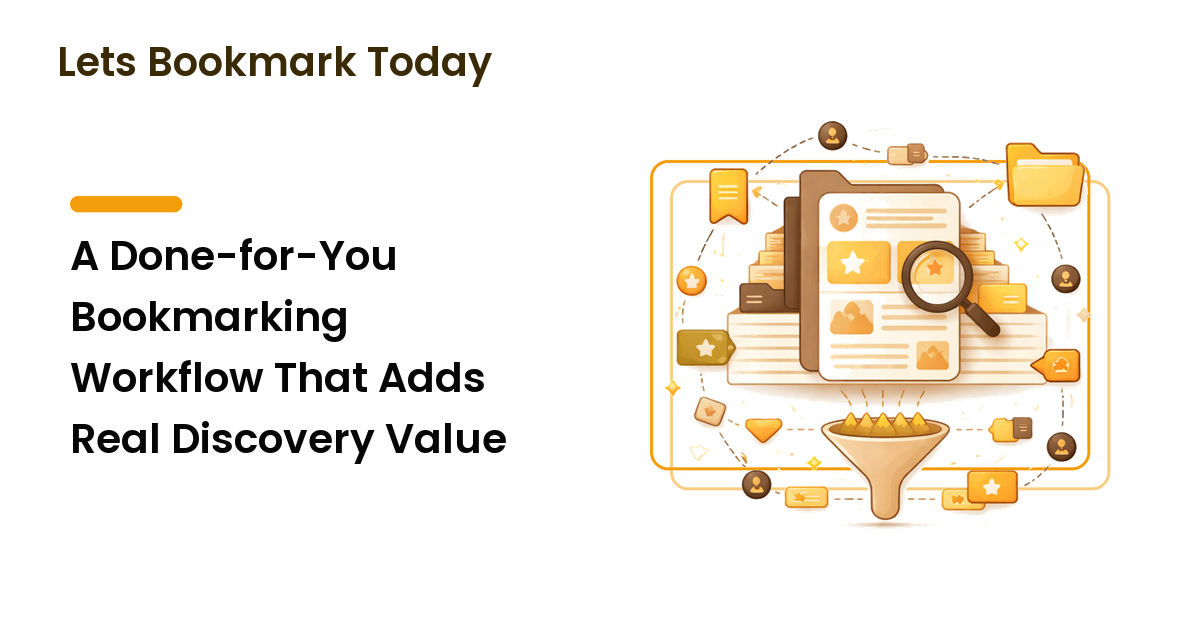
A workflow you can safely outsource has four decisions baked in, all made by you, once:
- What gets shared. Not everything. Pick the pages genuinely worth discovering — the ones with real depth or utility. Sharing thin content widely just spreads thin content.
- Where it goes. A vetted shortlist of active, relevant platforms. Quality over count. Five real communities beat fifty dead link-dumps every time.
- How it reads. Two or three title-and-blurb variations per page, written like a human recommending the link, so submissions don't look mechanically duplicated.
- At what pace. A schedule that drips submissions over days. Nothing about natural sharing happens in a single burst.
Write those four down and you have a workflow. Anyone — or any service — can now execute it without making a single judgement call. That's what makes the hand-off safe.
The spam-filter test, in plain terms
Before you scale anything, run your planned workflow against a simple test: would a careful human reading this feed think it was spam? If the same page appears on twenty platforms in an hour with an identical blurb, the answer is yes, and an automated filter will agree. If the same page appears on a handful of relevant platforms over a week, each with a natural description, it reads like genuine sharing.
The honest framing: filters aren't trying to punish you for sharing your own content. They're trying to catch volume without relevance. Keep relevance and pacing in your workflow and you're on the right side of that line by design, not by luck.
Sourcing the execution without buying junk
Once the workflow is designed and tested by hand, the repetitive execution is a reasonable thing to outsource — and the cleanest way is a wholesale marketplace that carries the production services behind one account, rather than a one-off "bookmarking gig" of unknown quality.
SEOeStore is a long-running example: social bookmarking and related distribution and indexing services are catalog items you order on demand. The reason it fits a done-for-you workflow specifically — breadth in one account means you can run the whole execution (submissions plus indexing) on one balance and one dashboard, against your shortlist, instead of trusting a random freelancer's idea of "bookmarking." It executes the labor; it doesn't replace your plan. You still decide what's shared, approve how it reads, and measure what worked.
Keep the discipline that keeps a done-for-you workflow clean:
- Brief your actual workflow. Hand over your pages, your vetted platforms, and your blurb variants — not a blank order.
- Test ten before a hundred. Confirm the submissions land on real, relevant platforms and read naturally.
- Walk away from volume pitches. "Hundreds of bookmarks overnight, guaranteed" is the spam cannon — exactly what you're avoiding.
- Pace and measure. Drip it, track indexing and any discovery, and keep only the platforms that show real signal.
Keep your hands on the parts that matter
The point of a done-for-you workflow is to free your time for what no service can do: choosing and creating content worth sharing, and showing up genuinely in the communities you care about. Let the marketplace handle the mechanical breadth; spend your reclaimed hours on quality and on the few places where a human presence actually matters. That balance is what makes the workflow an asset instead of a liability.
FAQ
Can a done-for-you bookmarking service ever be safe?
Yes — when you design the workflow and the service only executes it. The danger is letting the service make the judgement calls, which optimizes for volume and produces spam. Keep page selection, platform vetting, framing, and pacing in your hands.
How do I keep a done-for-you workflow from tripping spam filters?
Build relevance and pacing into the plan. Share only quality pages, to vetted active platforms, with varied human-sounding descriptions, dripped over days. Filters target volume without relevance — a paced, relevant workflow reads as genuine sharing.
Is paying for bookmarking and distribution against the rules?
Buying links purely to manipulate rankings is against search guidelines. Paying for the labor of distributing legitimate, relevant content to real platforms is an ordinary operational choice. The risk is in the quality and intent of what's placed, not in outsourcing the typing.
How small should my first test be?
Small enough to inspect every result — ten or so submissions. Check that they're live, on relevant platforms, reading naturally, and that anything got indexed. Only scale a workflow you've personally verified produces real listings.
Next step
Design the workflow first: write down what gets shared, where, how it reads, and at what pace — the four decisions only you can make. Run it by hand once to confirm it passes the careful-human test. Then, for the repetitive execution, brief that exact workflow and place a small test order through a wholesale marketplace like SEOeStore, and measure the discovery before you scale. That's how a done-for-you workflow adds real value instead of tripping every filter in sight.